










For years, the standard chat widget was little more than an annoying pop-up box with a stock photo of a woman in a headset. You asked a straightforward question about pricing or delivery, and it offered three irrelevant buttons before looping: “Sorry, I didn’t understand. Would you like to speak to an agent?” It resolved nothing, wasted the visitor’s time, and felt cheap.
The arrival of large language models changed the game technically, but it introduced a brand-new corporate fear: hallucination.
No managing director wants a generic public bot on their homepage making up non-existent refund policies, quoting half-price discounts, or chatting about the weather.
So, is putting an AI chatbot on your website actually a smart move, or is it just another piece of digital clutter?
The answer comes down to whether the bot is running on open-ended speculation or grounded in your specific, proprietary business knowledge.
The Difference: Scripted Bots vs. Grounded AI
To understand whether an AI assistant makes sense for your site, you have to look past the generic tools and understand how domain-specific models work.
- The Old Scripted Widget: Built on rigid decision trees. If a user types phrasing the developer did not explicitly anticipate, the bot breaks down. It cannot interpret nuance, slang, or complex intent.
- The Raw AI Bot: Sounds remarkably human, but knows nothing about your company. Left unguided, it guesses answers based on broad internet data—a massive commercial liability.
- The Grounded Model (Retrieval-Augmented Generation / RAG): This is the sweet spot. Instead of letting the AI guess, the system connects directly to your secure, internal documents: your technical spec sheets, pricing matrices, return policies, and service guides.
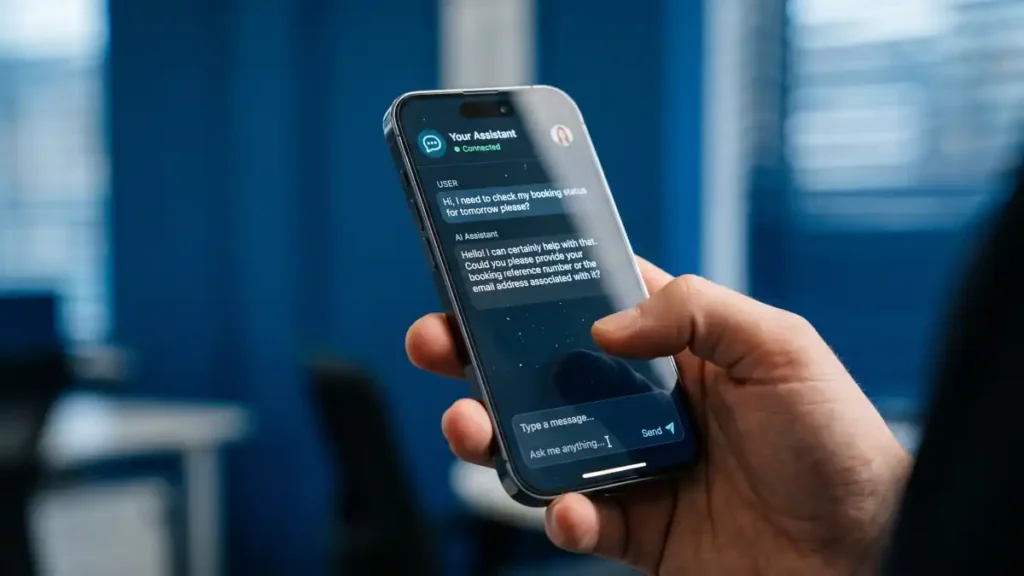
When a visitor asks a question, a grounded bot queries your private knowledge library first, extracts the verified facts, and uses natural conversational language to deliver the exact answer in seconds. If the information does not exist in your files, it does not invent an answer; it politely directs the user to a human team member.
When It Genuinely Adds Commercial Value
Adding an AI assistant makes immediate sense if your business experiences any of the following operational bottlenecks:
- Repetitive Inbound Enquiries: If your team spends twenty hours a week answering the same dozen questions about lead times, integration specs, or warranty terms, a grounded bot absorbs that volume instantly around the clock.
- High-Intent Out-of-Hours Traffic: Prospective clients researching services at 10:00 PM do not want to wait until 9:30 AM for a basic clarification. An intelligent assistant qualifies the enquiry, answers technical questions, and books a call directly into your calendar while interest is high.
- Extensive Product or Service Catalogues: If your website holds hundreds of SKUs, complex technical manuals, or dense policy documentation, asking visitors to trawl through navigation menus is friction. A conversational bot acts as an instant concierge, guiding them straight to what they need.
When You Should Skip It
Despite the current excitement around conversational tools, an AI chatbot is not a universal necessity:
Disorganised Internal Information: An AI assistant is only as competent as the data feeding it. If your internal documentation is outdated, conflicting, or incomplete, the bot will simply serve accurate confusion.
Low Traffic Volumes: If your website only receives a handful of visits each week, building and maintaining an AI integration offers negligible return. Pick up the telephone instead.
Highly Bespoke, Consultative Services: If every contract you write is completely unique, confidential, and cannot be captured in standard documentation, a bot will have very little useful data to draw from.
Practical Deployment: Keep It Focused
If you decide to deploy an AI chatbot, the rule is simple: give it a narrow, well-defined operational job.
Do not try to make it an all-singing corporate mascot. Anchor it strictly to your verified knowledge base, test it rigorously against edge cases, and ensure there is always a clean, one-click escalation path to a real human when a conversation demands genuine expertise.