











Can we just hand the whole inbox over to AI?
The short answer is no—not completely. Letting an autonomous system draft and fire off responses to your entire client base without supervision is an unnecessary commercial risk.
However, where modern AI does transform enterprise operations is in a slightly less glamorous, wildly effective workflow: document ingestion and data extraction.
The Core Problem: Unstructured Data
To understand why this technology matters, you have to look at how computers read information.
Computers love structured data: spreadsheets with tidy columns, databases with strict rules, and clean API payloads. If every supplier sent you an identical spreadsheet, you would never need AI. A basic script could ingest it in two seconds.
The problem is that business runs on unstructured data.
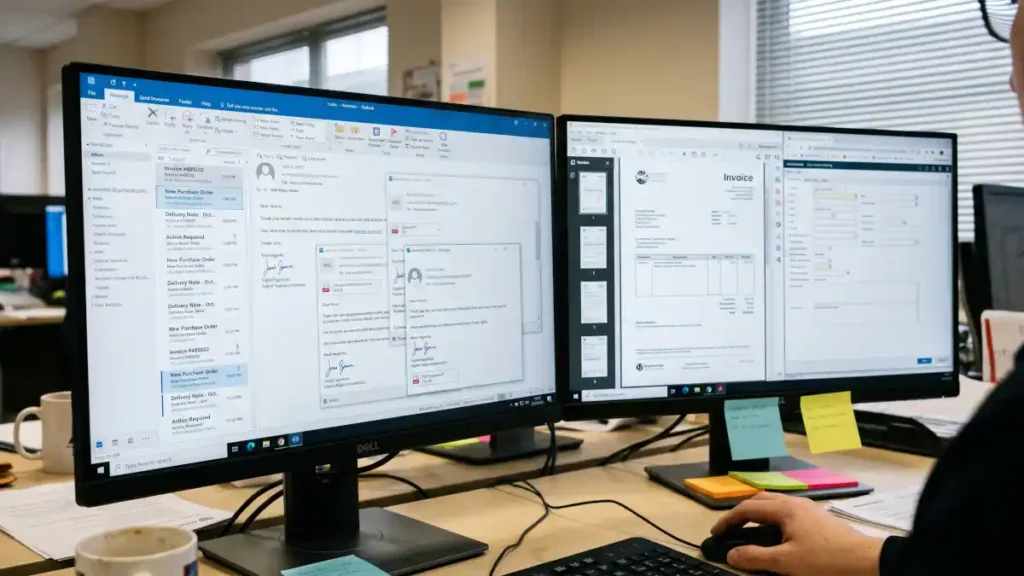
Supplier A sends an invoice as a clean vector PDF. Supplier B sends a scanned photo of a paper receipt taken on a phone. Supplier C embeds the order details directly into the body text of the email itself.
Historically, older optical character recognition (OCR) software was hopelessly brittle. If the layout of an invoice changed by three millimetres, the software broke down.
Modern multimodal AI models do not care about rigid templates. They read documents contextually, exactly like a human would. They can look at an invoice they have never encountered before, locate the total amount, isolate the VAT, verify the line items, and pull the purchase order number out in a fraction of a second.
The Realistic Workflow: From Inbound Attachment to Database Entry
Rather than imagining an all-knowing bot chatting with your customers, the high-value commercial application looks like a quiet, automated pipeline running in the background:
- Inbound Triage: An email hits your
invoices@ororders@inbox. An automated rule identifies whether the message contains an attachment or specific transaction-related keywords. - AI Document Ingestion: The system passes the attached PDF, image, or text to an AI processing layer. The model parses the unstructured file and converts it into clean, structured JSON data.
- Validation and Hygiene Check: The system checks the extracted figures against basic mathematical rules: Does Subtotal + VAT = Total? Does this supplier match an active record in our database?
- Direct System Entry: The verified figures are pushed straight into your accounting platform, ERP, or warehouse queue via webhooks or APIs.
- Human Sign-Off: If a document is blurry, a total doesn’t balance, or an invoice exceeds a certain spend threshold, the system flags it and drops it into a review queue for human sign-off.
No one had to re-type a number, yet your staff remain in complete control of the final financial approval.
Is It a Massive Risk?
The risk only manifests when leadership treats AI like a replacement for accountability rather than an administrative assistant.
- The Hallucination Danger: If you instruct an open-ended model to read complex contracts and make operational decisions without strict validation rules, it will occasionally misread an ambiguous field or invent a detail. That is unacceptable in financial accounting or compliance.
- The “Auto-Reply” Hazard: Giving an AI autonomous permission to hit “Send” on customer emails is rarely worth the headache. An automated model cannot gauge delicate political nuance with an upset customer or spot a cleverly disguised phishing attempt.
- The Privacy Consideration: Feeding proprietary enterprise attachments into public, free consumer tools is a data governance failure. Document ingestion pipelines must be engineered through dedicated, enterprise-grade endpoints where data is encrypted in transit and not used to train public models.
The Verdict: Worth It for the Right Jobs
Can AI run your entire email operation while your team goes to the beach? Absolutely not. Business relationships still require human discretion, empathy, and oversight.
Can it eliminate thousands of hours of manual data entry, parse messy PDF invoices effortlessly, and pull structured data out of inbound emails before your staff even arrive at their desks? Yes, without question.